
Art Therapy for Emotional Regulation: How Creative Expression Helps You Manage What Feels Unmanageable
No warning. No words. Just the feeling, already here. It arrives first as a tight chest, a clenched jaw, a wave of dread that shows up before you have any idea what it is about. You try to talk yourself down. It does not work, and the more you reach for words, the further the feeling seems to slip out of reach, until you are exhausted and no closer to calm.
That is not a failure of willpower, and it is not a sign that you are doing therapy wrong; it is simply how the nervous system is built, which means the answer is rarely more thinking.
I'm Elizabeth, a Licensed Creative Arts Therapist in Brooklyn, and I work with adults across New York who are tired of white-knuckling their way through emotions that feel far too big for the words available. Many of them are thoughtful people. They understand their patterns on paper. And still the feelings keep outrunning the explanation.
Why talking is not always enough
Emotional regulation is the ability to feel something intense and stay with it without being swept away. Not numbness. Not control. Something closer to riding the wave instead of drowning in it.
Here is the part that surprises people. Big emotions often live in parts of the brain that never learned to speak. When a feeling is stored in the body, in sensation and image and impulse, asking the thinking mind to explain it is a little like asking someone to describe a smell using only algebra. The information is real. The translation keeps breaking down.
This is common in anxiety, in trauma, and in the long shadow of early relationships where feelings were not welcome. Talk therapy still helps enormously. Sometimes, though, it needs another way in.
What art therapy really does
Art therapy is not an art class. Let me say that clearly, because the fear of being bad at art stops a surprising number of people at the door before they ever find out what the work is really for.
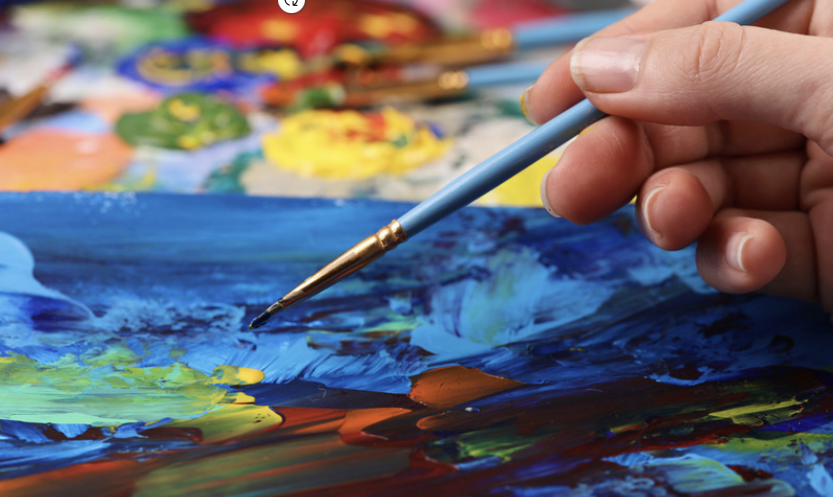
In creative arts therapy, we use image, color, texture, and movement to give a feeling somewhere to go that is not a sentence. You do not need talent. You do not need a single good idea. What you need is a willingness to make a mark and notice what happens next, and that is a much lower bar than most anxious perfectionists expect.
It slows the whole system down
Reaching for a pastel is slower than reaching for a thought. That slowness matters. When your hand moves across paper, your breathing tends to settle, your attention narrows to something concrete and manageable, and the racing commentary in your head loses a little of its grip. Regulation often begins in the body, well before it becomes an insight.
It externalizes what feels enormous
A dread that lives inside your chest can feel infinite. The same dread, scribbled hard in charcoal and sitting on the table in front of you, has edges. It has a size. You can look at it, turn it, decide it is finished. Getting a feeling out of your body and onto a surface where you can see it gives you a small, real sense of agency over something that a moment ago felt like it was running the whole show.
It lets you approach the hard stuff sideways
Some things are too tender to look at directly. Image lets you circle them. You can work at the edges of a grief or a fear through color and shape long before you are ready to name it out loud, and for a lot of people that sideways approach is what finally makes the unbearable approachable.
What a session can look like
People imagine something intimidating. The reality is gentler than that.
We might start with how your week truly felt, not the tidy summary you would give a coworker. Then, instead of only talking, I might invite you to put that feeling down in whatever form fits. Scribble the tension. Choose the color of the dread. There is no wrong version, because your image is not being judged as art; it is being read, gently and together, as information.
Afterward we look at what showed up. Often something is there that neither of us would have reached through conversation alone. A pattern. A softness. A part of you that had been waiting to be seen.
This connects closely to parts work therapy, where the different sides of you each get a voice and a turn at the table instead of being talked over. Sometimes a color speaks for a part that has no words yet.
Skills you can carry out of the room
The goal is not to need therapy forever. The goal is to leave with a bigger set of tools for the ordinary difficult moments that used to flatten you before you could even reach for a strategy.
Many clients find that a few simple practices travel well. A scribble pad by the bed for the nights when the mind will not settle. A color chosen for a mood before you try to explain it. These are small. They are also, for a lot of people, the difference between spiraling and staying with yourself through a genuinely hard hour.
If naming what you feel has always been hard, you might find my post on why some experiences are so difficult to put into words a useful companion to this one.
You do not have to manage it alone
Feeling flooded and out of words is not a character flaw. It is a very human place to be, one that a great many capable people find themselves in, and it is far more workable than it feels at two in the morning.
I offer individual therapy virtually across New York State, and many of the people I see are in Brooklyn and Manhattan, working from wherever they can find a door that closes. You do not need to arrive with the right words. You do not need any words at all.
If something here felt familiar, reach out when you're ready. No commitment. Just a conversation, and a chance to see whether this way of working fits you. You don't have to figure it out alone.